
Orléans, Ontario · St. Joseph Blvd
Timing Belt Replacement in Orléans
Empowering customers to make informed decisions.
- VIN checked before any belt quote
- Set to exact factory timing marks
- Licensed mechanics Alex and Dan
- Serving Orléans since 2013
Signs Your Timing Belt Is Failing
Quick Summary:
A failing timing belt gives off warning signs before it breaks, like ticking noises, engine misfires, or trouble starting. Catching these early saves your engine. Ignore them, and you're gambling with a bigger repair bill.
A timing belt doesn't just snap out of nowhere, most of the time. It wears down slowly, and your car tries to tell you before it fails. The tricky part is that the symptoms can feel small at first, easy to brush off as nothing.
We hear this all the time: a customer says the car's been making a weird ticking sound for a week, but it still runs fine so they figured it could wait. That's exactly the kind of thing we want you to call us about right away.
- A ticking or slapping noise coming from the front of the engine, usually worse at idle
- The engine cranks but won't start, or takes longer than normal to turn over
- Rough idling or a misfire that comes and goes for no clear reason
- Oil leaking near the front timing cover, since a worn seal often goes hand in hand with belt wear
- The check engine light coming on with any rough running or hesitation
Short trips add wear too. Folks doing a lot of stop-and-go driving on Innes Road or through busy Orléans intersections put more stress on engine parts than highway driving does. Belts age faster under that kind of use.
Not every noise means the belt is about to fail. Some of these signs overlap with a serpentine belt problem or a loose accessory. That's a much simpler fix.
Not sure which one it is? That's common, and it's not something you should try to guess at. Get it checked before it turns into a tow truck call.
Timing Belt vs. Timing Chain: Confirm What Your Car Has
Here's something a lot of folks don't realize: not every engine has a timing belt. Some have a timing chain instead, and chains are built to last the life of the engine in most cases. So before you book anything, we need to confirm which one your car has.
This matters because if you've got a chain, timing belt replacement isn't even on your radar. That's a different conversation entirely. We check this in about two minutes using your VIN and a quick look under the hood.
A few things tend to point toward a belt system:
- Smaller four-cylinder engines, especially older Honda, Toyota, and Mazda models
- A manufacturer maintenance schedule that lists a belt interval around 100,000 to 160,000 km
- No metallic rattling noise at startup, which is more common with a worn chain
Some newer engines have moved back to chains for durability. Some older ones you'd expect to have a chain run a belt.
If your owner's manual mentions an interference engine and lists a timing belt interval, that's your answer. If it doesn't mention a belt at all, don't let anyone talk you into replacing one that isn't there.
Not sure which one you've got? Bring us your VIN or your owner's manual. We'll tell you straight, no guessing games.
When You Don't Need a Timing Belt Replacement Yet
Not every car needs this. Some engines use a timing chain instead of a belt, and chains are built to last the life of the vehicle in most cases. The first thing we check is whether your engine even has a belt at all. No belt, no worry.
If your car does have a timing belt, mileage and time both matter. According to GATES, most manufacturers set an interval somewhere between 100,000 and 160,000 kilometers, or a set number of years, whichever comes first.[1] If you're well under that number and the belt was never exposed to oil or coolant leaks, you can usually wait.
- Your vehicle has a timing chain, not a belt
- You're still well below the manufacturer's recommended interval
- The belt was replaced recently and there's paperwork to show it
- You have no oil or coolant leaks near the engine's timing cover
- No unusual ticking, whining, or rough idle when you start the car
Here's a scenario we see a lot. Someone buys a used car, finds an old service sticker mentioning belts or hoses, and panics. When we pull the maintenance history, the belt's already been done and there's plenty of life left.
Waiting isn't reckless when the numbers support it. But guessing is a different story. If you don't know your mileage since the last replacement, that's worth a quick check, not a full repair.
What Happens During a Timing Belt Replacement
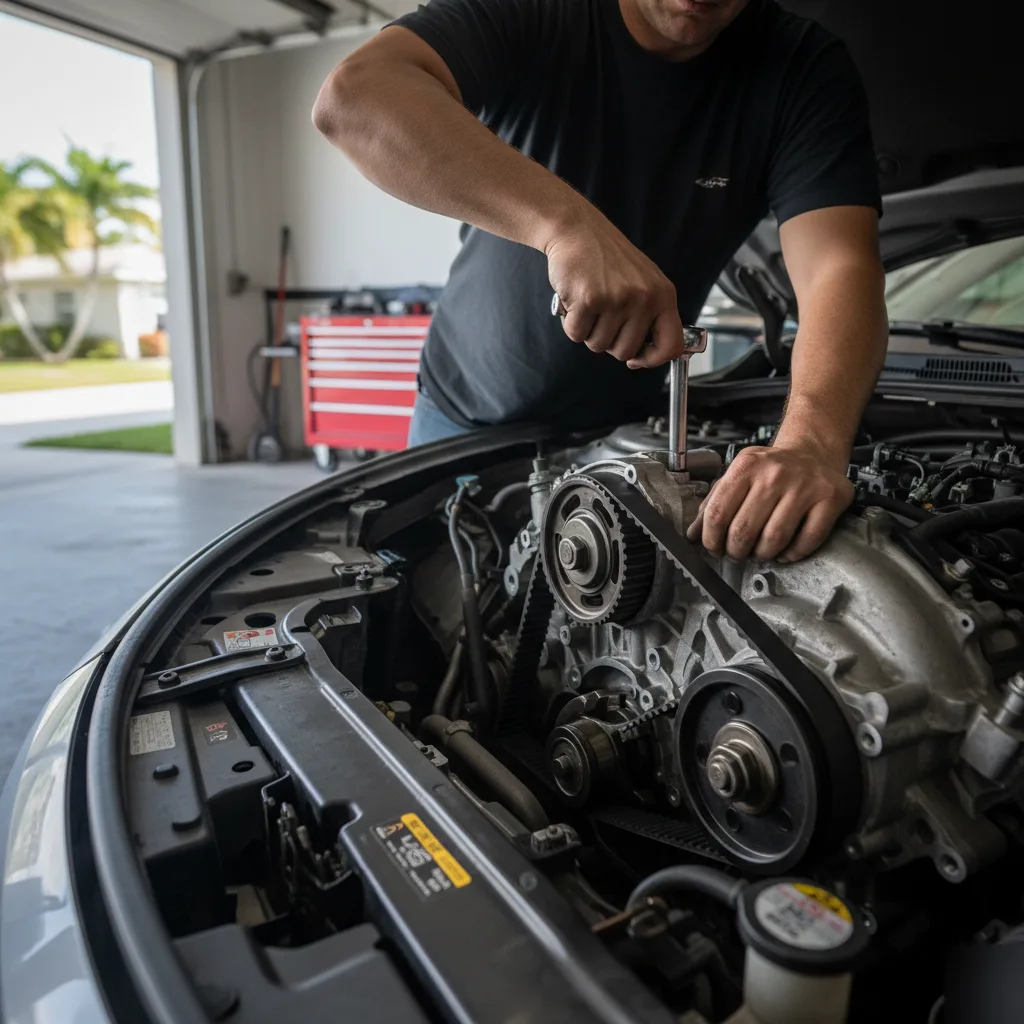
So what happens when your car's up on the hoist? It's not a quick swap. The timing belt sits deep behind the engine's front cover. Getting to it means pulling off several other parts first. Once we're in there, we often find the water pump and serpentine belt showing wear too. That's not a sales pitch, it's just physics. Parts that live in the same spot, under the same heat and tension, tend to wear out around the same time.
- We pull codes and do a visual check first, confirming the belt needs replacing before touching anything.
- Front accessories, covers, and sometimes the crank pulley come off to expose the timing components.
- We remove the old belt and check the tensioner, pulleys, and water pump for wear.
- The new belt goes on and gets set to exact factory timing marks. This step can't be rushed.
- We reassemble everything, then start the engine and check for smooth idle and no unusual noise.
- We photograph the worn parts along the way as part of our digital inspection, so you can see what we saw.

Winters here get hard on rubber. Cars parked outside near Highway 174 see wide temperature swings that make old, brittle belts more likely to slip or crack overnight. That's part of why we check tension carefully every time.
You'll get a text with photos before we move forward on anything extra. That's just how we work. No surprises when you pick up the keys.
Cold-Climate Belt Wear for Orléans Commuters
Rubber hates the cold. When temperatures drop below negative twenty, which happens plenty around here most winters, timing belt rubber gets stiff before the engine warms up. That stiffness means more cracking, more flex fatigue, every time you start the car on a January morning.
Here's the part a lot of folks miss.
Short trips make it worse. If your daily drive is stop-and-go on Innes Road during rush hour, the belt never gets a long, steady warm-up. It heats a little, cools a little, heats again. That cycle wears the belt faster than steady highway driving would, even if your total mileage looks fine on paper. Add road salt spray and slush getting flung up near the front of the engine bay, and you've got conditions that age a belt faster than the manufacturer's chart accounts for.
We see this every week during cold snaps. We get more belt inspection requests and more customers asking if a squeal on startup means trouble.
- Squealing or chirping on cold starts, especially before the engine warms up
- A belt that looks glazed or shiny instead of matte black
- Small cracks running across the ribs, easier to spot in daylight after a cold night
- Loose tension you can feel if you press on the belt with the engine off
None of these mean panic. But they mean it's worth a look, especially if your car sits outside overnight through an Orléans winter.
Frequently Asked Questions
How long does a timing belt replacement take?
Most timing belt jobs take a full day because the belt sits deep behind the engine's front cover. We have to remove several other parts first to reach it. While we're there, we check the water pump, tensioner, and pulleys too, since they wear out around the same time. We text you photos along the way so you can see exactly what we found before we button everything back up.
What should I bring when I take my car in for a timing belt check?
Bring your owner's manual or VIN if you have it, plus any old service records. We use your VIN to confirm in about two minutes whether your engine even has a timing belt or a timing chain instead. If you've got paperwork showing a past belt replacement, that helps us figure out if you're still well within your safe mileage window.
Does cold weather in Orléans make timing belts wear out faster?
Yes, cold weather is hard on rubber timing belts. Cars parked outside near Highway 174 see big temperature swings that make old, brittle belts more likely to crack or slip overnight. If your belt is already near the end of its interval, winter stress can push it over the edge faster than a car kept in a garage. That's why we check tension closely on every inspection.
How do I know if my car has a timing belt or a timing chain?
Check your owner's manual first for a listed belt replacement interval, usually between 100,000 and 160,000 kilometers. Chains don't have this kind of interval because they're built to last the life of the engine. Smaller four-cylinder engines, especially older Honda, Toyota, and Mazda models, are more likely to run a belt. If you're not sure, bring us your VIN and we'll confirm it in minutes.
What happens if I ignore the early signs of a failing timing belt?
Ignoring the signs can turn a routine repair into a tow truck call. A ticking noise, rough idle, or trouble starting are your car's early warnings before the belt breaks. Stop-and-go driving around busy Orléans intersections, like Innes Road, adds extra wear that speeds this up. Catching the symptoms early keeps the repair simple. Waiting too long risks serious engine damage if the belt snaps while driving.
Will you replace the water pump at the same time as the timing belt?
Often, yes, if it's already showing wear. The water pump sits in the same area as the timing belt and faces the same heat and tension, so it tends to wear out on a similar timeline. When we're already in there checking the belt, tensioner, and pulleys, it makes sense to look closely at the pump too, so you don't need a second teardown later.